



Software Development
JavaScript
Node.js
What is Node.js in 2026: Why JavaScript on the Server Changed Everything
JavaScript used to live in the browser. Then Node.js freed it. Now it powers the backend of Netflix, LinkedIn, Uber, PayPal, and millions of applications worldwide. This is the story of how one runtime environment changed the entire web development landscape.
The Problem Node.js Solved
For decades, web development meant learning two completely different languages: JavaScript for the frontend (the browser) and something else for the backend - PHP, Ruby, Python, Java, C#. This created friction. Frontend developers couldn't contribute to backend code. Backend developers couldn't touch frontend logic. Every company needed separate teams with separate skill sets.
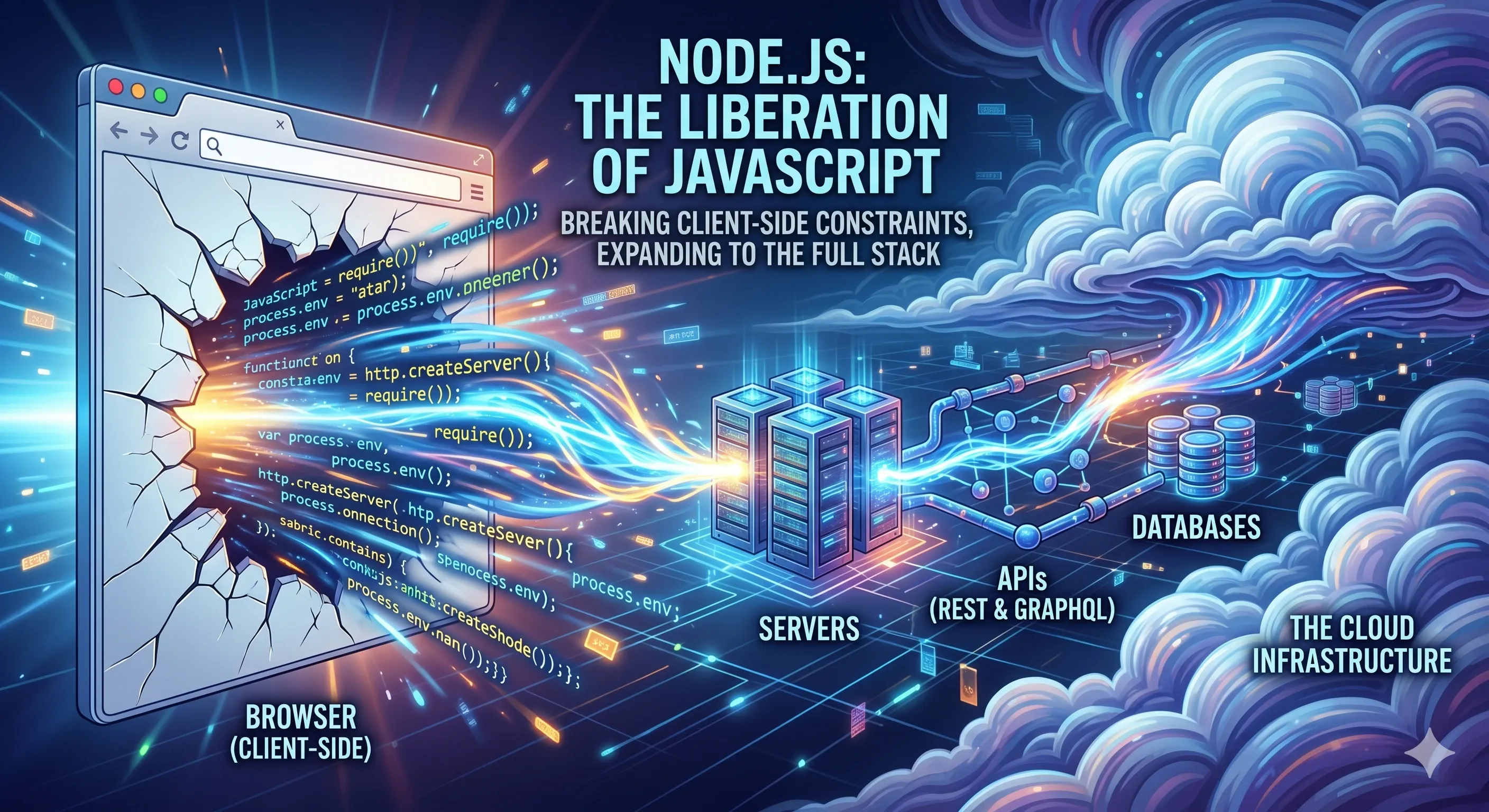
Then in 2009, Ryan Dahl released Node.js - a runtime that let JavaScript run outside the browser, on servers. Suddenly, the same language that handled button clicks and form validation could also handle HTTP requests, database queries, file systems, and network communication.
This wasn't just convenient. It was transformational.
One language across the entire stack meant:
- Developers could work on frontend and backend with the same mental model
- Codebases became smaller and more maintainable
- Startups could build faster with smaller teams
- The JavaScript ecosystem exploded - npm became the largest package registry in the world
By 2026, Node.js isn't just popular. It's fundamental. Understanding Node.js isn't optional if you want to build modern web applications - it's table stakes.
What Node.js Actually Is
Node.js is a JavaScript runtime environment. That sentence is technically correct but doesn't explain why it matters. Let's break it down.
JavaScript Runtime
A runtime is the environment where your code executes. Browsers have runtimes (Chrome's V8 engine, Firefox's SpiderMonkey) that execute JavaScript in the context of web pages. Node.js is a runtime that executes JavaScript in the context of your operating system - directly on your machine or server, with access to the file system, network, and system resources.
Node.js uses the same V8 JavaScript engine that powers Google Chrome, but it strips away the browser-specific APIs (DOM,
window object, etc.) and adds server-specific capabilities (file I/O, HTTP servers, child processes, etc.).Event-Driven, Non-Blocking I/O
This is the architectural choice that makes Node.js fast and scalable.
Event-driven means Node.js operates on an event loop. When an asynchronous operation (like reading a file or querying a database) is initiated, Node.js doesn't wait for it to complete. It moves on to the next task, and when the operation finishes, an event is emitted, and the callback executes.
Non-blocking I/O means Node.js can handle thousands of concurrent connections without creating a new thread for each one. Traditional servers (like Apache with PHP) create a new thread or process per connection, which is resource-intensive. Node.js handles everything in a single thread with an event loop, making it lightweight and efficient.
Real-world impact: Node.js can handle 10,000+ concurrent WebSocket connections on a single server with minimal memory usage. This is why it's the default choice for real-time applications - chat apps, live dashboards, multiplayer games, collaborative tools.
Cross-Platform
Node.js runs on macOS, Windows, Linux, and even in serverless environments like AWS Lambda, Google Cloud Functions, and Vercel Edge Functions. Write once, run anywhere.
What You Can Build with Node.js
Node.js isn't just for one type of application. It's a general-purpose backend runtime. Here's what modern developers build with it in 2026:
REST APIs & GraphQL Servers
The most common use case. Node.js frameworks like Express.js, Fastify, and Koa make building HTTP APIs fast and straightforward. Whether you're building a mobile app backend, a microservice, or a full web API, Node.js handles it.
Real-Time Applications
WebSockets, Server-Sent Events, and real-time communication are where Node.js shines. Chat applications (Slack, Discord), live collaboration tools (Figma, Notion), streaming platforms, and multiplayer games all leverage Node.js's non-blocking architecture.
Serverless Functions
AWS Lambda, Vercel Edge Functions, Cloudflare Workers - all support Node.js. You write a function, deploy it, and it scales automatically. Node.js's fast startup time and small memory footprint make it ideal for serverless architectures.
Full-Stack Applications with Next.js
Next.js runs on Node.js and handles both frontend rendering and backend API routes in the same codebase. This "full-stack in one framework" approach has become the standard for modern web apps.
CLI Tools & Build Scripts
Node.js isn't just for servers. Developers use it to build command-line tools (npm, Webpack, ESLint, Prettier), automation scripts, and development tooling. The entire JavaScript ecosystem's toolchain runs on Node.js.
Microservices & Distributed Systems
Node.js is lightweight enough to run hundreds of microservices efficiently. Companies like Netflix, Uber, and LinkedIn use Node.js microservices architectures to scale globally.
Node.js vs Other Backend Languages
Let's address the obvious question: why choose Node.js over Python, Java, PHP, or Go?
| Feature | Node.js | Python (Django/Flask) | Java (Spring Boot) | Go |
|---|---|---|---|---|
| Language | JavaScript | Python | Java | Go |
| Use Case | Full-stack web, APIs, real-time apps | Data science, web apps, automation | Enterprise apps, large systems | High-performance APIs, systems programming |
| Performance | Very fast (V8 engine) | Moderate | Fast (after JVM warmup) | Extremely fast |
| Concurrency Model | Event-driven, single-threaded | Multi-threaded (sync) or async (newer) | Multi-threaded | Goroutines (extremely efficient) |
| Real-Time Capabilities | Excellent (WebSockets, SSE) | Good | Good | Excellent |
| Package Ecosystem | npm (largest registry) | pip (large, mature) | Maven/Gradle (enterprise-focused) | Go modules (growing) |
| Learning Curve | Low (if you know JavaScript) | Low | Steep | Moderate |
| Full-Stack Possibility | Yes (same language frontend/backend) | No | No | No |
| Best For | Startups, full-stack teams, real-time apps | Data-heavy apps, ML/AI, scripting | Large enterprises, banking, finance | Cloud infrastructure, DevOps tools |
The Node.js advantage: If you already know JavaScript (and every frontend developer does), Node.js lets you become full-stack without learning a second language. That's a genuinely big deal.
Why Node.js Dominates in 2026
1. The JavaScript Ecosystem is Unmatched
npm has over 2.5 million packages. Need authentication? Use Passport.js. Need to process images? Use Sharp. Need to send emails? Use Nodemailer. Whatever you're building, there's a battle-tested library for it.
2. Full-Stack JavaScript is the Default
Modern web development is increasingly full-stack. Developers who can build a React frontend and a Node.js backend are more valuable than specialists in either alone. Node.js makes this transition seamless.
3. Hiring is Easier
Finding JavaScript developers is easier than finding Ruby or Scala developers. The talent pool is massive because JavaScript is the most widely used programming language globally.
4. Serverless and Edge Computing
The future of backend is increasingly serverless and edge-based. Node.js's lightweight runtime and fast cold-start times make it the best fit for these architectures. Vercel, Netlify, Cloudflare, AWS Lambda - all optimize for Node.js.
5. TypeScript Makes Node.js Enterprise-Ready
TypeScript (JavaScript with static types) has made Node.js viable for large, complex codebases. Companies that wouldn't have considered JavaScript a decade ago now use TypeScript + Node.js for mission-critical systems.
How Node.js Works Under the Hood
Understanding the event loop is key to understanding why Node.js is fast.
The Event Loop
Node.js runs on a single thread but handles thousands of concurrent operations. How? The event loop.
- Your code runs
- Asynchronous operations (file I/O, network requests, timers) are offloaded to the system
- Node.js continues executing other code
- When an async operation completes, its callback is added to the event queue
- The event loop picks up callbacks from the queue and executes them
Example:
console.log('Start');

setTimeout(() => {
  console.log('Timeout callback');
}, 0);

console.log('End');
Output:
Start
End
Timeout callback
Even though
setTimeout is set to 0ms, it's asynchronous. The callback goes to the event queue and only executes after the synchronous code finishes.Non-Blocking I/O in Practice
Traditional blocking code:
const data = readFileSync('large-file.txt'); // Blocks here until done
console.log(data);
console.log('This waits');
Node.js non-blocking code:
readFile('large-file.txt', (err, data) => {
  console.log(data);
});
console.log('This runs immediately');
The second version doesn't wait. It starts reading the file, moves on, and processes the file data when it's ready. This is why Node.js can handle 10,000 concurrent requests - it doesn't wait for any single operation to complete.
Common Node.js Misconceptions
"Node.js is only for small apps"
False. Netflix, LinkedIn, Uber, PayPal, NASA - all use Node.js in production at massive scale.
"Single-threaded means slow"
False. Node.js is single-threaded for JavaScript execution, but I/O operations are handled by the system's thread pool. For I/O-bound tasks (which most web apps are), Node.js is very fast.
"Node.js isn't suitable for CPU-intensive tasks"
Partially true. Node.js isn't ideal for tasks like video encoding or complex mathematical calculations that block the event loop. But you can offload those to worker threads or separate services.
Learning Node.js in 2026
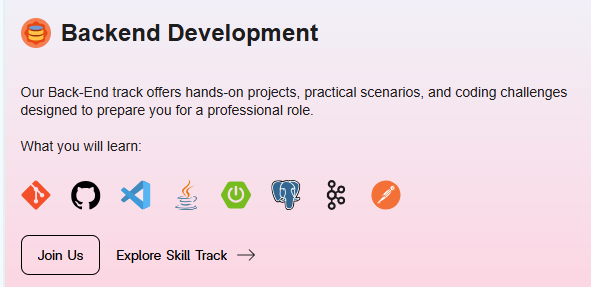
Node.js isn't a standalone skill - it's the foundation of backend JavaScript development. At Archi's Academy, Node.js is woven into both the Backend Development track (where you build APIs, work with databases, and deploy servers) and the Frontend Development track (where you use Next.js and understand how server-side rendering works).
Start with Node.js Fundamentals
Learn the core concepts: modules, the event loop, asynchronous programming, file system operations, and HTTP servers.
Build APIs with Express.js
Express.js is the most widely used Node.js framework for building APIs. Learn routing, middleware, error handling, and connecting to databases.
The Full Development Tracks
Node.js is integrated into both tracks at Archi's Academy because it's fundamental to modern web development - whether you're building APIs or rendering server-side React.
Learn by Doing. Prove by Doing. Get Hired.

The Bottom Line: Node.js Changed Everything
Before Node.js, JavaScript was a language you tolerated for making web pages interactive. After Node.js, JavaScript became a language you could build entire companies on.
It's not perfect. It's not the best choice for every problem. But it's the most versatile, the most accessible, and the most employable choice for web development in 2026.
If you're learning to code, learn JavaScript. And once you know JavaScript, learning Node.js means you're no longer just a frontend developer - you're a full-stack developer. That's a career-changing skill.
Have questions about Node.js, backend development, or where to start with server-side JavaScript? The Archi's Academy team is here to help - reach out anytime.

Friday, Jan 1, 2021