




Software Development
Computer Science
Testing
SDLC vs STLC in 2026: Why Understanding Both Lifecycles Makes You Irreplaceable
Building software without testing it is optimism. Testing software without understanding how it was built is guesswork. The developer who understands both owns the entire process.
The Question No One Asks Until It's Too Late
You've shipped the feature. It works on your machine. You've tested the happy path - user clicks button, form submits, success message appears. Perfect.
Then production crashes at 3am because someone entered a phone number with spaces in it and your validation logic assumed they wouldn't. Or the payment gateway times out under load. Or the mobile app shows a white screen on iOS 17.4 specifically. Or the database migration you ran deleted 10,000 user records because the WHERE clause was one line too high.
Here's the thing: none of these are coding problems. They're process problems. They're what happens when development runs without systematic testing, or when testing runs without understanding how development actually works.
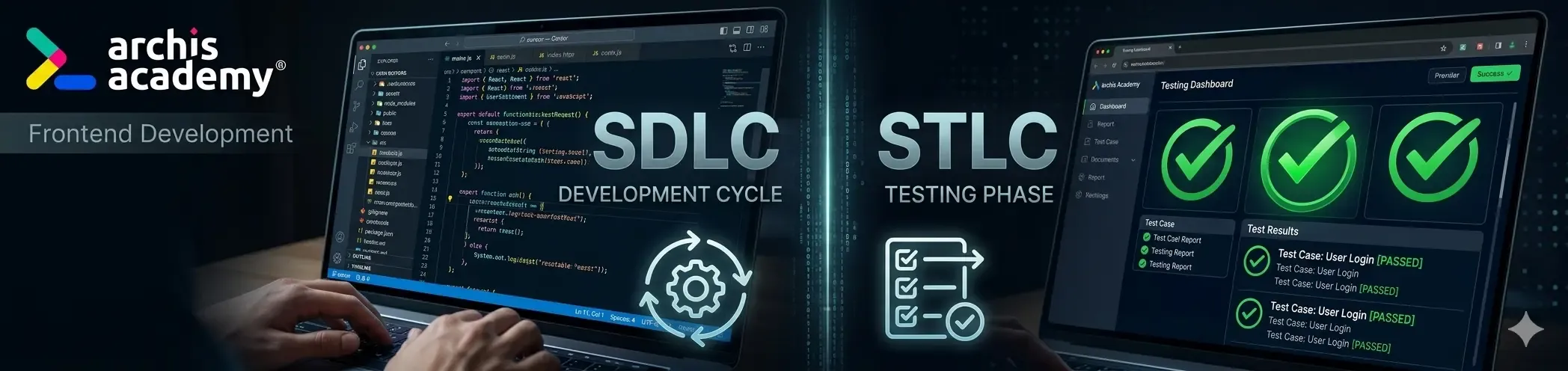
SDLC (Software Development Life Cycle) is how software gets built. STLC (Software Testing Life Cycle) is how we know it actually works. In 2026, the line between the two is more blurred than ever - and the professionals who understand both are the ones teams can't afford to lose.
What SDLC and STLC Actually Are
Let's start with the definitions, but keep them grounded in what actually happens on a real team.
SDLC is the structured process of taking an idea - "we need a checkout button" - and turning it into deployed, working code. It includes requirement gathering, design, coding, testing, deployment, and maintenance. Every software project follows some version of this, whether it's documented or not.
STLC is the parallel process of ensuring that what was built actually does what it's supposed to do. It's the systematic approach to writing test cases, setting up test environments, executing those tests, logging bugs, and confirming fixes.
The critical insight: STLC doesn't happen after SDLC. It runs alongside it. Test planning starts as soon as requirements are defined. Test cases are written while code is being developed. Execution begins the moment features are ready. The two lifecycles are woven together, not sequential.
SDLC Phases: The Journey from Idea to Production
Here's how modern software actually gets built:
1. Requirement Gathering
The team defines what needs to be built. Product managers, stakeholders, and engineers collaborate to turn business needs into technical specs. This is where ambiguity gets resolved before it becomes expensive.
2. System Design
The architecture takes shape. How will the database be structured? What APIs are needed? What frameworks will we use? This is where technical decisions lock in.
3. Implementation (Coding)
Developers write the actual code. Features get built, APIs get wired up, UIs get styled. This is the phase most people think of when they think "software development."
4. Testing
QA teams execute the STLC in full here - running test cases, finding bugs, validating fixes. This phase overlaps heavily with STLC's test execution.
5. Deployment
The code goes live. CI/CD pipelines automate the process, but someone still has to monitor it, verify it, and roll it back if something breaks.
6. Maintenance
Bugs get fixed. Features get refined. Dependencies get updated. The cycle never actually ends - it just moves to the next iteration.
STLC Phases: How We Know It Actually Works
While developers are building, testers are preparing. Here's the STLC breakdown:
1. Requirement Analysis (from a testing perspective)
QA reads the same requirements document as the developers - but asks different questions. "What happens if the user enters invalid data? What's the expected behaviour on slow networks? What edge cases exist?"
2. Test Planning
The test strategy takes shape. What types of testing are needed? (Unit, integration, regression, load, security.) What tools will be used? Who's responsible for what?
3. Test Case Development
Specific, repeatable test cases get written. "Click the checkout button with an empty cart. Expected result: error message appears and checkout is blocked." These test cases become the source of truth.
4. Environment Setup
Test environments get configured - staging servers, test databases, mock payment gateways. The goal is to mirror production as closely as possible without risking real user data.
5. Test Execution
The actual testing happens. Manual testers click through flows. Automated test suites run. Bugs get logged. Failed tests get documented.
6. Test Cycle Closure
Metrics get reviewed. What percentage of tests passed? How many critical bugs were found? Is the feature ready to ship or does it need another round?
SDLC vs STLC: The Visual Breakdown
Here's the comparison that makes the distinction clear:
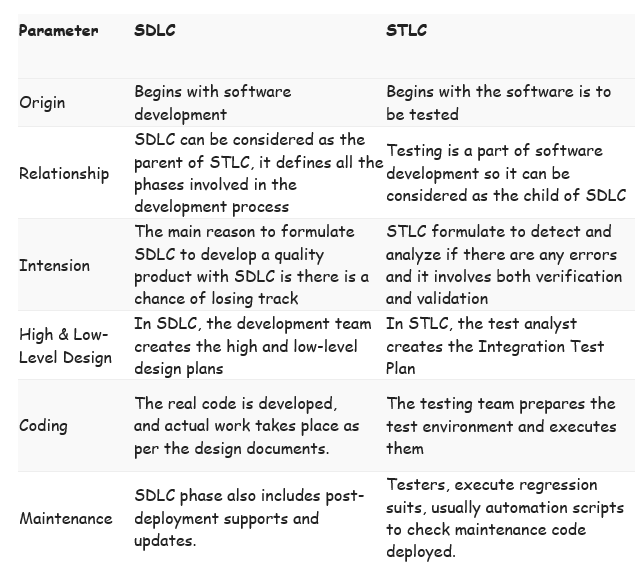
| Feature | SDLC (Software Development Life Cycle) | STLC (Software Testing Life Cycle) |
|---|---|---|
| Primary Goal | Build and deliver the software product | Verify and validate the product's quality |
| Driven By | Business and technical requirements | Testing and quality requirements |
| Key Phases | Design, development, deployment, maintenance | Test planning, execution, defect tracking, closure |
| Output | Working software application | Test results, bug reports, quality metrics |
| Who Owns It | Developers, designers, product managers | QA analysts, test engineers, automation specialists |
| When It Happens | Entire project lifecycle | Parallel to development, intensifies during testing phase |
A Real Example: E-Commerce Checkout Flow
Let's make this concrete with a scenario every team has faced.
SDLC in action:
The product team defines a requirement: "Add a promo code field to the checkout page." The designer mocks it up in Figma. A frontend developer builds the input field and the "Apply" button in React. A backend developer writes an Express API route that validates promo codes against the database and returns the discount. The feature gets deployed to staging.
STLC in action:
Before the feature even ships, a QA analyst writes test cases:
- Valid promo code → discount applies correctly
- Expired promo code → error message appears
- Invalid promo code → error message appears
- Empty field → button is disabled
- Promo code applied twice → second attempt fails gracefully
- User removes promo code → price reverts to original
Each test case gets executed. A bug is found: the discount calculates incorrectly on orders above $500. The bug gets logged, fixed, retested, and closed. Only then does the feature ship to production.
The relationship: SDLC delivered the feature. STLC ensured it actually worked. Neither could succeed without the other.
How AI and Automation Are Changing Both Lifecycles in 2026
The SDLC and STLC of 2026 look meaningfully different from even three years ago. AI tools and automation have entered both lifecycles at every layer.
In SDLC:
- GitHub Copilot and Cursor write entire functions from natural language prompts. Developers describe what they need, AI generates the implementation.
- CI/CD pipelines have become the default - every commit triggers automated builds, tests, and deployments.
- Infrastructure as Code (IaC) means environments are version-controlled and reproducible.
In STLC:
- Automated testing frameworks (Playwright, Cypress, Selenium) run entire test suites on every commit. What used to take a QA team hours now runs in minutes.
- AI-powered test generation tools can analyse a UI and generate test cases automatically - though human review is still critical.
- Visual regression testing tools (Percy, Chromatic) catch UI bugs that manual testers might miss.
- Load and performance testing (k6, Apache JMeter) simulates thousands of concurrent users to find bottlenecks before production does.
But here's the reality check: automation doesn't eliminate the need to understand the process - it raises the bar for what "understanding" means. The tester who can write a Playwright script and interpret its results is more valuable than the one who only knows manual testing. The developer who understands what their CI pipeline is testing and why is shipping more reliable code than the one who just clicks "merge."
The Mistakes Teams Still Make
Treating testing as an afterthought. If STLC only begins after development is complete, you're finding bugs when they're most expensive to fix. Start test planning the moment requirements are defined.
Siloed teams. When developers don't talk to testers until bugs appear, resentment builds. Collaboration throughout the lifecycle prevents this.
Over-relying on automation without strategy. Automated tests are only as good as the test cases they execute. Automating bad tests just means you're failing faster.
Skipping regression testing. Every new feature risks breaking old ones. Without systematic regression testing, tech debt compounds invisibly until a major refactor is required.
Where to Learn SDLC and STLC Properly
Understanding these lifecycles conceptually is one thing. Applying them to real projects - writing test cases, setting up CI pipelines, logging bugs properly, understanding when to ship and when to delay - is what actually makes you valuable to a team.
At Archi's Academy, both lifecycles are covered through dedicated courses:
Software Development Life Cycle — Learn the end-to-end process of building software from requirements to deployment.
→ Start the SDLC Course for Free →
Software Testing Foundation — Master the systematic approach to testing, from test planning to execution and defect management.
→ Start the STLC Course for Free →

The Backend Development track and Frontend Development track both embed SDLC and STLC principles directly into the project work - because understanding the process is inseparable from understanding the code.
Learn by Doing. Prove by Doing. Get Hired.

Questions about how SDLC and STLC apply to your specific learning path? The Archi's Academy team can help you figure out where to start - reach out here.

Tuesday, Dec 14, 2021