



Software Development
Productivity
Front end
Story
Resume is DEAD: Let Real-World Projects Speak for You
Recruiters spend an average of seven seconds on a resume. They'll spend seven minutes on a portfolio that shows real code, real projects, and real results. The question is no longer what you say you can do - it's what you've already built.
The Resume Problem Nobody Talks About
Picture this. You spend two hours perfecting your resume. You tailor the summary, quantify your bullet points, match keywords to the job description. You hit submit. Then nothing.
Not because you're unqualified. Because a hundred other people did exactly the same thing with resumes that read almost identically to yours. "Proficient in React." "Experience with REST APIs." "Strong communicator." "Team player." Every resume in the pile says the same things. And in a job market where a single junior developer role receives three hundred applications, saying the right things on paper no longer separates anyone.
This is the resume problem in 2026: the document that was designed to represent your value has become so standardised that it no longer differentiates you from anyone else who completed the same bootcamp, the same tutorials, or the same degree program.
The developers who are getting hired aren't winning with better resumes. They're winning by bypassing the resume entirely - with portfolios of real, working, verifiable projects that let employers see exactly what they can build.
What Employers Are Actually Looking For in 2026
The hiring conversation has shifted. It's not that resumes are completely irrelevant - they still serve as the initial filter. But the question that actually drives hiring decisions has changed.
Employers no longer ask "what have you done?" and accept a list of responsibilities as an answer. They ask "can you show me?"
This shift is backed by how hiring actually works at tech companies in 2026. Recruiters screen for keywords. Hiring managers then look at GitHub profiles, portfolio sites, and project links before deciding who to interview. The resume gets you past the algorithm. The portfolio gets you the call.
What a project portfolio communicates that a resume cannot:
- How you structure code and approach architecture decisions
- Whether you write documentation and commit messages a team could actually work with
- How you handle real constraints: deadlines, incomplete requirements, breaking changes
- Whether your projects actually run - not just theoretically, but right now, in a browser
- That you build things when nobody assigned them to you, which signals genuine interest
This is the difference between telling a recruiter you know React and showing them a deployed Next.js application with a clean component structure, accessible UI, and a documented README. One is a claim. The other is evidence.
Resume vs Project Portfolio: What Each Actually Shows
| What Employers Want to Know | Resume | Project Portfolio |
|---|---|---|
| Can you write working code? | Claims it | Proves it |
| Do you understand real project structure? | Implied by job titles | Visible in every repository |
| Can you work with version control? | Listed as a skill | Demonstrated by commit history |
| Have you shipped something real? | Vague ("delivered projects") | Live URL or deployed demo |
| Do you keep learning independently? | Hard to assess | Visible in project dates and diversity |
| Can you document your work? | N/A | README files, PR descriptions |
| How do you handle complexity? | Can't tell | Architecture and folder structure show it directly |
The portfolio doesn't replace the resume. It makes every claim on the resume credible.
Breaking the "Experience Required" Loop
The most common frustration for junior developers entering the market sounds like this: you need experience to get hired, but you need to be hired to get experience. Every job posting asks for two years of experience on a framework that's been around for eighteen months. Every entry-level role expects a portfolio of production work that you can only build if someone already trusted you with a production environment.
This is real. And it is genuinely unfair.
But the developers who break out of this loop do it by understanding something important: the loop assumes that experience only comes from employment. It doesn't.
A GitHub repository you built on a weekend, a deployed side project that solves a real problem, a contribution to an open-source library, a collaboration with another developer on a joint project - these all count as experience. Not in the bureaucratic "two years on the job" sense, but in the sense that actually matters: you have written code that does a real thing, you have made decisions under constraints, and you have something a hiring manager can open in a browser right now.
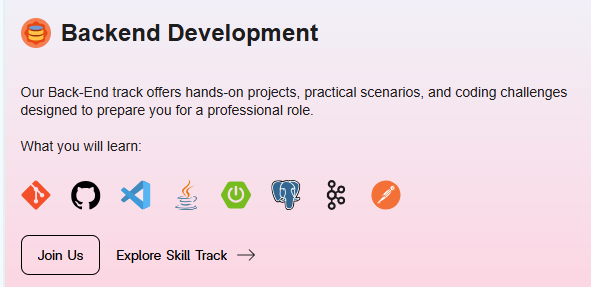
At Archi's Academy, the entire learning model is built around solving this exact problem. Instead of tutorial exercises that exist only inside a course platform, the Frontend Development track and Backend Development track are structured as work simulations - scoped tickets, pull requests, code reviews - that produce real portfolio artefacts. By the time you finish, your portfolio is already built.
What Makes a Project Portfolio Actually Impressive
Not all project portfolios are equal. A GitHub profile full of tutorial clones and half-finished to-do list apps is barely better than no portfolio at all. What separates a portfolio that generates interview calls from one that gets ignored comes down to a few consistent factors.
It Solves a Real Problem
The strongest projects come from a genuine frustration or need. An app that tracks something the developer personally wanted to track. A tool that automates something they actually had to do manually. A dashboard that surfaces information they genuinely needed. Hiring managers can tell the difference between a project built to tick a box and a project built because someone cared about the outcome.
It Actually Works
This sounds obvious. It isn't. Many developer portfolios are full of projects that throw errors when you actually run them, APIs that return 404s, and demos that require setup steps the recruiter won't follow. A deployed project with a real URL - even a simple one - is worth more than an impressive-looking local codebase that nobody can see.
The Code Is Readable
Senior developers reviewing portfolios look at source code. They look at whether you've structured components logically, whether you've handled edge cases, whether your naming is consistent, and whether another developer could understand what's happening without asking you. Clean, readable code signals that you've thought about how your work fits into a team context.
There's a Clear README
A README that explains what the project does, why you built it, how to run it locally, and what technologies you used is a small detail that carries disproportionate weight. It signals communication skills, professionalism, and consideration for other developers - all things that matter enormously to teams that have to maintain code.
It Shows Range and Growth
A portfolio of five nearly identical CRUD applications tells a less compelling story than three projects that each demonstrate something different. One that shows front-end work. One that shows API integration or backend logic. One that shows you've worked with real data or an interesting constraint. Range shows adaptability. Growth across projects shows someone who keeps pushing.
Pronto para transformar conhecimento em habilidades reais?
Comece a construir com formacao guiada por projetos e ganhe experiencia pratica desde o primeiro dia.
How Archi's Academy Builds Your Portfolio Through Work Simulations
The hardest part of building a portfolio for most self-taught developers isn't the coding. It's knowing what to build, how to structure it, and how to get feedback that improves it.
Watching tutorials gives you syntax. Working through exercises gives you practice. Neither gives you the experience of receiving a real brief, interpreting ambiguous requirements, making architecture decisions, writing code that gets reviewed, and iterating based on feedback. That experience - the experience that resembles actual work - is what the Archi's Academy approach is built around.
Every project in the curriculum is structured like a real engineering task: a scoped ticket with acceptance criteria, a pull request process where your code gets reviewed by an experienced instructor, and feedback that mirrors what you'd receive from a senior developer on a real team. You're not just building projects - you're building them the way professionals build them.
When you finish a track, you don't have a certificate from a course. You have a portfolio of projects built under real conditions, with code review history that hiring managers can read, and the ability to talk through your decisions in an interview because you actually made them.

Why This Matters for Your Career
The developers entering the market in 2026 are doing so at a genuinely interesting moment. AI tools have lowered the barrier to generating code, which means the market is about to be flooded with people who can produce working code without deeply understanding it. That sounds threatening. It's actually an opportunity.
Because what AI cannot fabricate is a portfolio of real projects with real commit histories, real design decisions, and the ability to explain in an interview exactly why you made those decisions. AI can generate a to-do app. It cannot generate the judgment that comes from having built something real, received feedback on it, and improved it.
Employers who understand this - and the best ones do - are becoming more selective about exactly this quality. Not "can you produce code" but "do you understand what you've built and can you defend it?" A portfolio answers that question before the interview even starts.
The resume gets you in the door. The portfolio gets you the offer.
Learn by Doing. Prove by Doing. Get Hired.
Have questions about building your portfolio or which track fits your goals? The Archi's Academy team works with developers at every stage - reach out anytime.

Çarşamba, Oca 8, 2025