



Technology
Productivity
HTML
Story
CV Mastery for Software Development Jobs: What Every Student Needs to Know
TL;DR:
CV mastery for software development requires moving beyond simply listing programming languages to actually demonstrating your ability to build and ship real-world projects. By replacing generic skill lists with a structured portfolio of work simulations, a clean GitHub history, and clear technical positioning, junior developers can bypass automated filters and immediately prove their value to technical recruiters.
What Is CV Mastery for Software Development?
CV mastery for software development is the strategic presentation of a candidate's technical skills, project portfolio, and coding experience to quickly prove their capability to hiring managers.
In today’s competitive tech landscape, having technical skills is no longer enough; the real challenge for students is learning how to present their skills in a way that gets noticed.
A strong technical CV acts as a focused highlight reel, emphasizing:
Real-world problem solving
Clean code practices
Ability to work within professional software engineering environments
Why It Matters
One of the key insights shared during a recent session with our CEO was simple: most CVs are not rejected because students lack ability, they are rejected because they fail to communicate value.
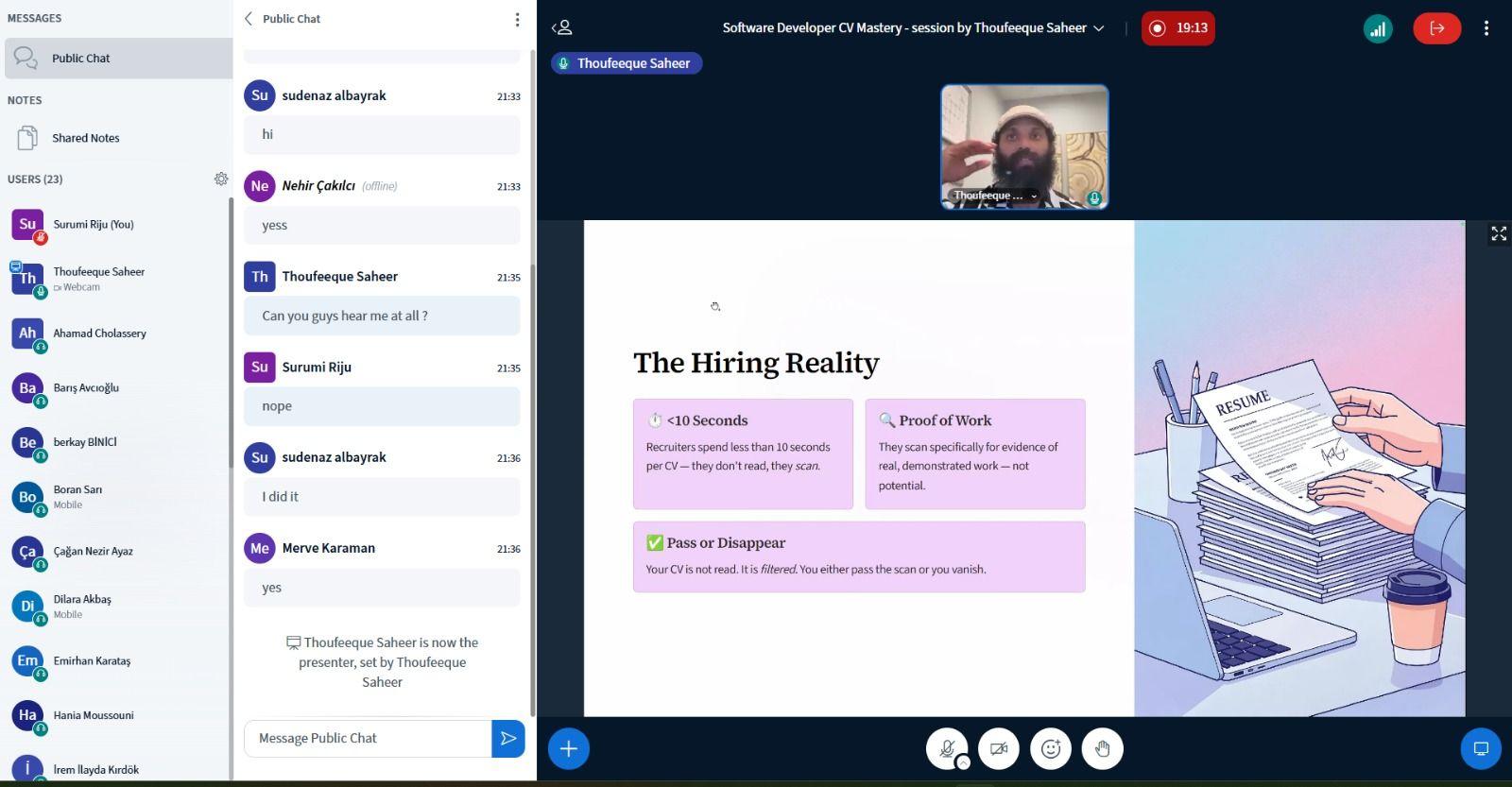
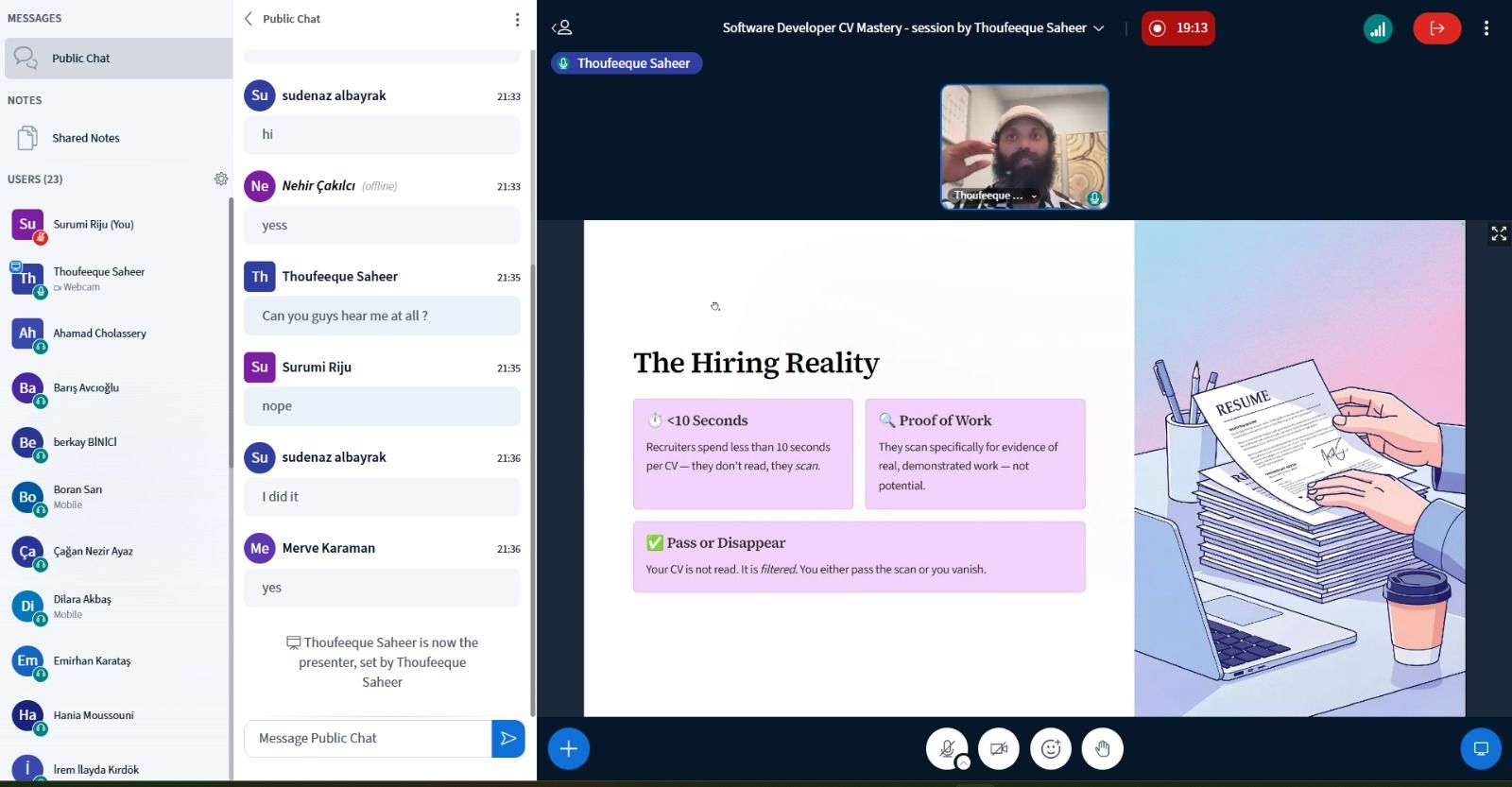
Recruiters typically spend less than 10 seconds scanning a CV. In that short time, they look for:
Can this candidate build something?
Do they have practical exposure?
Are they focused or scattered?
A strong CV is not a summary of what you have studied; it is a reflection of what you have built.
İçerikleri gerçek becerilere dönüştürmeye hazır mısın?
Proje tabanlı eğitimle hemen başla, ilk günden itibaren uygulamalı deneyim kazan.
How It Works: The Anatomy of a Winning Tech CV
1. A Clean Header
Include:
Name
Contact information
GitHub profile
Personal portfolio link
2. A Focused Skills Section
Group skills logically (Frontend, Backend, DevOps)
Avoid listing everything
Only include technologies you can confidently explain
3. A Strong Projects Section
This is the most important section.
For each project, include:
- Purpose
- Features
- Technologies used
- Impact
If applicable, highlight:
- Agile workflows
- Pull requests
- Code reviews
- Team collaboration
4. GitHub and Digital Proof
Your GitHub should:
- Have clean, structured repositories
- Include proper documentation
- Show consistent commits
This builds immediate credibility.
Practical Steps: Building a CV That Gets Interviews
Choose a Specific Domain
Focus on frontend, backend, or full-stack.
Complete Work Simulations
Work on projects that mimic real engineering workflows.
Focus on Positioning
Replace weak statements like:
“Created a website using HTML and CSS”
With:
Clear explanation of architecture, problems solved, and impact.
Iterate and Apply
Don’t wait for perfection. Apply and improve continuously.
Common Mistakes: Why Most Student CVs Fail
Listing every technology
No proof of work
Too much focus on academics
Poor formatting and readability
Comparison: Traditional vs Optimized CV
Traditional Student CV
Focus: Coursework and grades
Skills: Long, unorganized lists
Experience: Unrelated jobs
Proof: None
Format: Text-heavy
Optimized Developer CV
Focus: Projects and technical skills
Skills: Grouped by domain
Experience: Work simulations, open-source
Proof: GitHub + live projects
Format: Clean, scannable
FAQ
Do I need a computer science degree?
No. Practical skills and projects matter more.
How many projects should I include?
2–3 strong, high-quality projects.
Should I include non-technical jobs?
Only if they show transferable skills.
Best CV format?
Clean, single-column, ATS-friendly.
No experience, what do I do?
Treat projects and simulations as your experience.
Conclusion
Getting hired is not about how much you have learned, it is about how effectively you demonstrate your ability to build.
Focus on:
- Real projects
- Clear positioning
- Strong proof of work
Start building, start documenting, and position yourself as a capable software engineer ready to add value from day one.

Pazar, May 3, 2026