



Gamification
Gamification Series -2- Flow Theory
Gamification, as I mentioned in last week’s blog, is an effective method to build desired behavior change in education as well as in the business world. However, in order to do that, people -or the users let’s say- should have enough motivation, not only at the beginning stage of the process but also till the end of it. In other words, they should “be in the flow”.
Mihaly Csikszentmihalyi defines flow theory as a mental state and feeling, where a person concentrates on a clear goal without outer disruptions and enjoys what he/she is doing. The theory also suggests that an activity should be hard enough to challenge the person, but also not so hard to discourage them. This may sound familiar to those who are involved in educational sciences as Krashen proposed his input hypothesis (i+1) in a quite similar fashion.
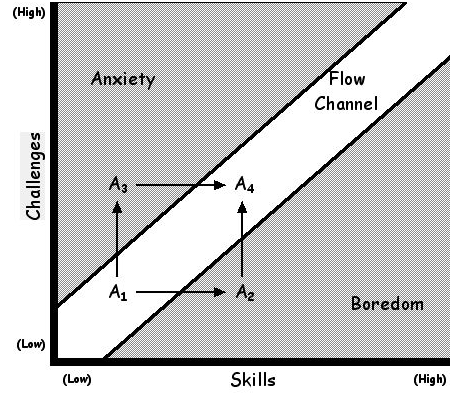
As it can be seen from the image above*, the difficulty or features of a task should match with the current level of skills of the person to get him/her in the flow. Relatively too easy tasks will cause boredom whereas too hard tasks will create anxiety and avoidance. In time, both skills and challenges should change in parallel so that a continuous learning process becomes possible.
So… when are we in flow? There is no fixed activity to define this since it depends on the person, but there are some characteristics of this state. One of the main features is that the person is intensely focused on one thing with a clear goal. A feeling of control and autonomy and loss of time perception are also other main characteristics. Another feature is that the person feels that the activity is rewarding with an inner motivation that arises as he/she gets immediate feedback. In short, it defines a balance between the thing we like to do and its subjective and optimum challenge level. We might be in flow we are gaming, researching, gardening, etc. Just think for yourself now… When are you in flow?
As we go back to our main point, in order to gamify our systems, we need to find ways to keep the user in flow. Since this is a very important concept in gamification, I’ll be digging more into this and explain how you can gamify your own systems, even your life.
Stay tuned!
*Csikszentmihalyi, M. (1990). Flow: The psychology of optimal experience. New York: Harper & Row.

Pazartesi, Eki 11, 2021