



Rest Assured
API Automation Testing
What is REST API?
REST API in 2026: The Universal Language Every Backend Developer Must Speak
Every app you've ever used talks to a server. REST APIs are how they talk. If you can't build one, you can't build anything that scales.
The Invisible Infrastructure Behind Everything
You open Instagram. Your feed loads instantly - hundreds of photos, perfectly personalized. You don't think about how that happened. You just scroll.
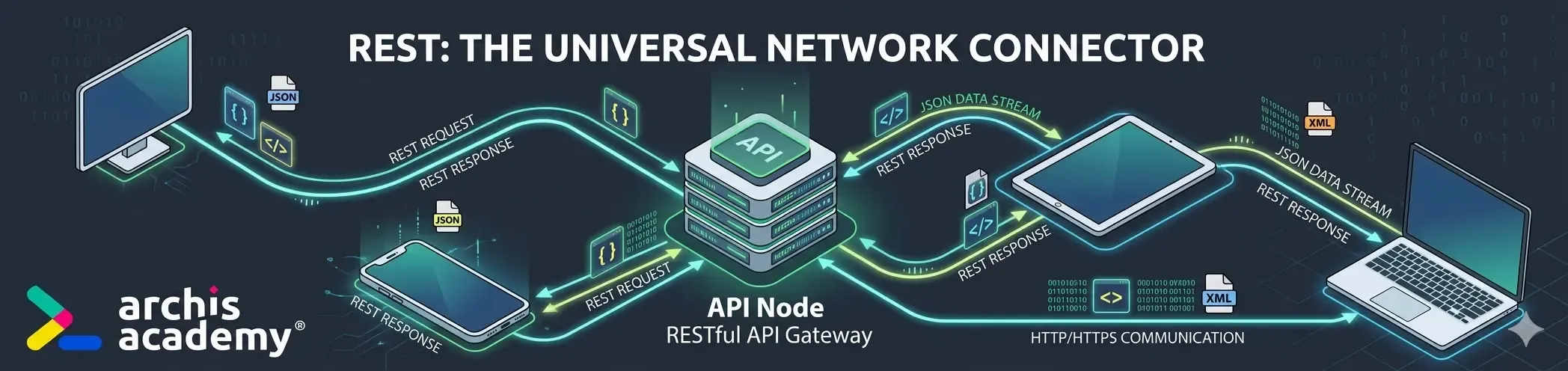
Behind that screen, your phone sent an HTTP request to Instagram's servers. The server queried multiple databases, applied recommendation algorithms, filtered content based on your preferences, and sent back a JSON response containing exactly the data your app needed to render that feed. All of this happened in milliseconds. All of this happened through a REST API.
You order food on DoorDash. You book a flight on Skyscout. You check your bank balance. You play a multiplayer game. You send a message on Slack. Every single one of these interactions - every button click, every form submission, every real-time update - is powered by APIs talking to servers in the background.
REST APIs are the invisible infrastructure of the internet. And in 2026, if you can't design, build, and secure one, you can't build modern software. It's that fundamental.
What REST API Actually Means
Let's break down the acronym properly:
REST = Representational State Transfer
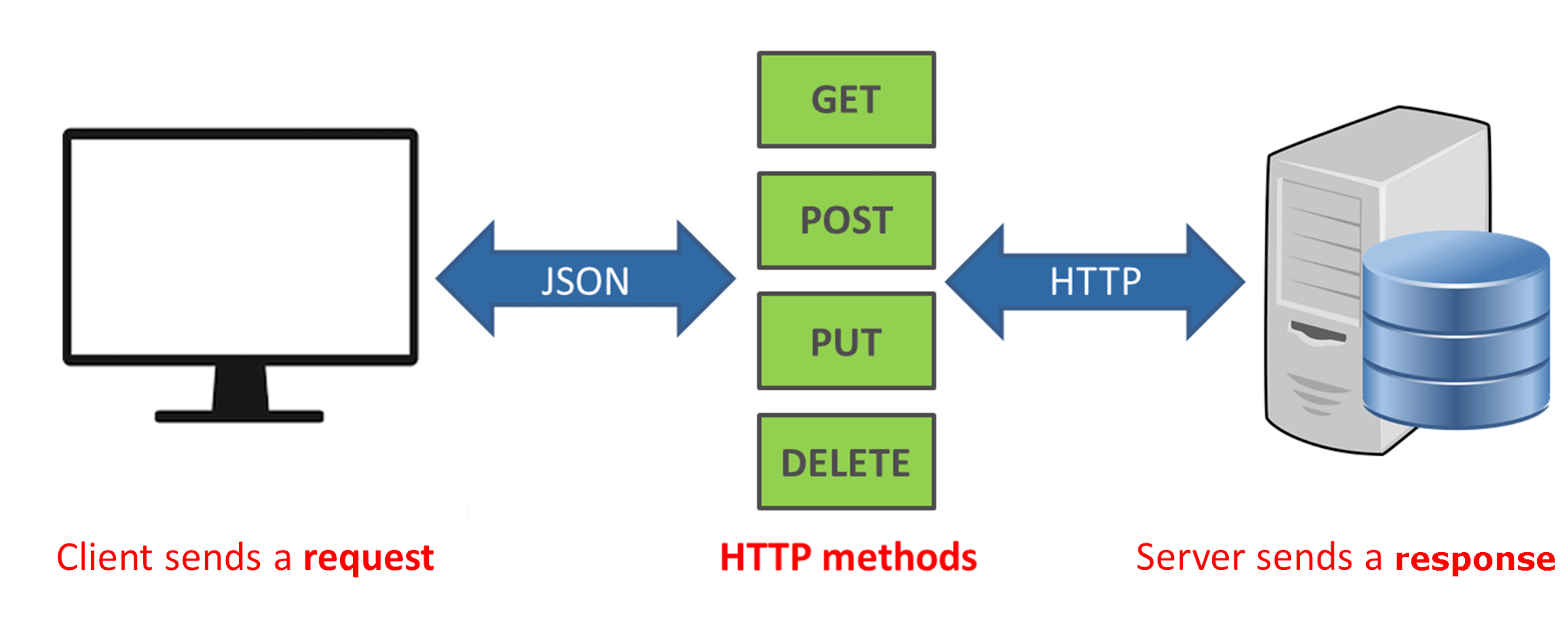
A set of architectural principles for designing networked applications. REST defines how clients (your phone, browser, app) and servers communicate over HTTP using standard methods like GET, POST, PUT, and DELETE.
A set of architectural principles for designing networked applications. REST defines how clients (your phone, browser, app) and servers communicate over HTTP using standard methods like GET, POST, PUT, and DELETE.
API = Application Programming Interface
A contract that defines how two pieces of software can talk to each other. The API is the set of endpoints (URLs) your server exposes, and the rules for how clients can interact with them.
A contract that defines how two pieces of software can talk to each other. The API is the set of endpoints (URLs) your server exposes, and the rules for how clients can interact with them.
Put them together: A REST API is a web service that follows REST principles and uses HTTP to let clients request and manipulate resources (data) on a server.
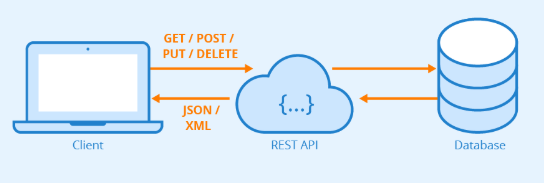
Here's the pattern in practice:
Client makes a request →
Server sends a response → JSON data containing the track's metadata (title, artist, album, duration)
GET https://api.spotify.com/v1/tracks/3n3Ppam7vgaVa1iaRUc9LpServer sends a response → JSON data containing the track's metadata (title, artist, album, duration)
That's it. That's how Spotify's app talks to Spotify's servers. That's how every modern application works.
The Anatomy of a REST API Request
Every REST API request has four components:
1. The Endpoint (URL)
The specific resource you're trying to access. Example:
https://api.github.com/users/octocat/repos
This endpoint returns all repositories for the user "octocat".
2. The HTTP Method
Defines what action you're performing:
- GET - Retrieve data (read-only, doesn't modify anything)
- POST - Create new data
- PUT - Update existing data (full replacement)
- PATCH - Update existing data (partial modification)
- DELETE - Remove data
Example:
GET /users retrieves users. POST /users creates a new user.3. The Headers
Metadata about the request. Common headers include:
Authorization: Bearer <token>- Proves you have permissionContent-Type: application/json- Tells the server you're sending JSON dataAccept: application/json- Tells the server you expect JSON back
4. The Body (for POST/PUT/PATCH)
The actual data you're sending. Usually JSON.
{
  "name": "Alice",
  "email": "[email protected]",
  "role": "admin"
}
The server receives this, validates it, processes it, and sends back a response - usually with a status code (200 OK, 201 Created, 400 Bad Request, 404 Not Found, 500 Server Error) and a JSON body containing the result or an error message.
REST API vs API: What's the Difference?
API is the general concept - any interface that lets two programs communicate. This includes REST APIs, but also GraphQL APIs, SOAP APIs, gRPC APIs, and more.
REST API is a specific type of API that follows REST principles and uses HTTP. It's the most common type of API for web applications because it's simple, stateless, and works naturally with the web's existing infrastructure.
| Feature | REST API | Other APIs |
|---|---|---|
| Protocol | Always HTTP/HTTPS | Can use HTTP, TCP, or custom protocols |
| Data Format | Usually JSON (sometimes XML) | JSON, XML, Protobuf, custom binary formats |
| Architecture | Resource-based URLs (e.g., /users/123) | Method-based (GraphQL), action-based (SOAP) |
| Statefulness | Stateless (each request is independent) | Can be stateful or stateless |
| Best For | Standard CRUD operations, web/mobile apps | Complex queries (GraphQL), high-performance microservices (gRPC) |
REST won because it's simple, scalable, and ubiquitous. Every programming language has libraries for making HTTP requests. Every server framework supports REST out of the box.
The Technologies That Power REST APIs in 2026
HTTP - The Foundation
Every REST API runs on HTTP. Understanding HTTP status codes, methods, headers, and how requests/responses work is non-negotiable.
JSON - The Data Format
JavaScript Object Notation has become the de facto standard for REST API responses. It's human-readable, compact, and natively supported in every programming language.
{
  "id": 123,
  "username": "alice",
  "posts": [
    { "id": 1, "title": "Hello World" },
    { "id": 2, "title": "REST APIs Explained" }
  ]
}
OAuth 2.0 - The Security Layer
Most production APIs use OAuth 2.0 for authentication and authorization. Instead of sending usernames and passwords with every request, clients receive a token that proves they're authorized to access the API.
Learn more about OAuth in our Authentication with Auth0 course.
Webhooks - The Reverse API
Instead of clients constantly polling the server ("Has anything changed? Has anything changed?"), webhooks let the server push updates to the client when something happens. Example: Stripe sends a webhook to your server when a payment succeeds.
Building REST APIs in 2026: The Frameworks
You don't build REST APIs from scratch. You use a framework that handles routing, request parsing, response formatting, and error handling for you. Here are the most common choices in 2026:
Express.js (Node.js)
The minimalist framework that powers millions of Node.js APIs. Simple, flexible, and the default choice for JavaScript/TypeScript backends.
Django (Python)
Python's most complete web framework. "Batteries included" - authentication, admin panel, ORM, and REST framework extensions all built in.

Spring Boot (Java)
The enterprise-grade framework for building production-scale APIs. Common in finance, healthcare, and large corporations. Verbose but powerful.
REST API Design Principles That Actually Matter
Building an API that works is one thing. Building an API that other developers want to use is another. Here are the principles that separate good APIs from bad ones:
1. Use Nouns, Not Verbs, in URLs
❌ Bad:
✅ Good:
/getUsers, /createUser, /deleteUser✅ Good:
GET /users, POST /users, DELETE /users/123The HTTP method already describes the action. The URL should describe the resource.
2. Be Consistent with Pluralization
Pick plural (
/users) or singular (/user) and stick with it across your entire API. Most APIs use plural.3. Nest Resources Logically
If comments belong to posts, structure your endpoints accordingly:
GET /posts/123/comments        → Get all comments on post 123
POST /posts/123/comments       → Create a new comment on post 123
DELETE /posts/123/comments/456 → Delete comment 456 from post 123
4. Use HTTP Status Codes Correctly
- 200 OK - Request succeeded
- 201 Created - New resource created successfully
- 400 Bad Request - Client sent invalid data
- 401 Unauthorized - Authentication required
- 403 Forbidden - Authenticated but not allowed
- 404 Not Found - Resource doesn't exist
- 500 Internal Server Error - Server crashed
5. Version Your API
Breaking changes happen. Version your API from day one.
https://api.example.com/v1/users
https://api.example.com/v2/users
This lets you evolve the API without breaking existing clients.
Want to learn API design systematically? We've got you covered:
Vibe Coding REST APIs: How AI Changes API Development in 2026
Building REST APIs has changed dramatically with AI-powered development tools. Here's how modern developers work:
1. Describing Endpoints in Plain English
Instead of writing every route by hand, developers describe what they need:
"Create an Express.js endpoint that accepts POST requests to /users, validates email and password, hashes the password with bcrypt, saves the user to MongoDB, and returns a JWT token."
Cursor or GitHub Copilot generates the entire route - validation middleware, error handling, database calls, and all.
2. Generating OpenAPI Documentation Automatically
Tools like Swagger generate interactive API documentation from your code comments. AI tools can now write those comments for you, keeping your docs in sync with your implementation automatically.
3. Writing Tests Before Implementation
Describe the expected behavior, and AI generates the test suite. Run it (it fails), then write the implementation to make it pass. TDD (Test-Driven Development) becomes faster when AI handles the boilerplate.
But here's the critical insight: AI generates code. It doesn't understand why an API should return 400 vs 422, or when to use PUT vs PATCH, or how to structure endpoints for scalability. The developer who understands REST principles can use AI to move faster. The developer who doesn't understand them is just shipping AI's mistakes at speed.
Common REST API Mistakes (and How to Avoid Them)
Not validating input data. Trusting client input without validation is how SQL injection, XSS attacks, and crashes happen. Always validate and sanitize.
Exposing internal implementation details. Your API should abstract away how the server works. If your database table is called
usr_accounts, your API endpoint should still be /users.Ignoring pagination. Returning 10,000 records in one response will crash mobile clients and slow down browsers. Paginate large datasets with
?page=1&limit=50.Not handling errors consistently. Every error response should have the same structure. Example:
{
  "error": "Validation failed",
  "message": "Email is required",
  "code": 400
}
Forgetting to rate limit. Without rate limiting, a malicious client can DDoS your API with thousands of requests per second. Implement rate limiting from day one.
Where to Learn REST API Development
REST APIs aren't a standalone topic - they're the backbone of backend development. At Archi's Academy, the Backend Development track is built around project-based scenarios where you design, build, test, and deploy REST APIs in real-world contexts - not just theory, but working applications.
You'll build with Express.js, Django, Spring Boot, and learn the architecture principles that make APIs scalable, secure, and maintainable.
Learn by Doing. Prove by Doing. Get Hired.
Have questions about REST APIs, backend development, or which framework to start with? The Archi's Academy team is here to help - reach out anytime.

Cumartesi, Mar 20, 2021