



Software Development
Technology
Computer Science
What is Vue.js? A Complete Guide to the Vue.js Framework
Vue.js in 2026: The Complete Guide to the Framework That Makes Frontend Development Click
Every frontend developer eventually has to pick a framework. React dominates headlines. Angular dominates enterprises. But Vue.js? Vue quietly powers some of the most loved, fastest-shipping web applications in the world - and there's a reason developers who try it don't go back.
Why Vue.js Deserves Your Attention
You've heard of React. You've heard of Angular. Maybe you've even started learning one of them.
But if you're building for the web in 2026 and you've never seriously looked at Vue.js, you're missing something important.
Vue isn't a consolation prize for developers who couldn't figure out React. It isn't a toy framework for small projects. It's the framework that Alibaba built their product interfaces on. It's what GitLab uses for their frontend UI. It's what teams reach for when they want React-level power without React-level complexity.
And for a certain kind of developer - someone who values clear code, fast onboarding, and a framework that actually makes sense from day one - Vue is simply the right tool.
This guide explains what Vue.js actually is, how it works, why it's different from React and Angular, and how to go from zero to job-ready with it.
What is Vue.js?
Vue.js (usually just called Vue, pronounced like "view") is an open-source, progressive JavaScript framework for building user interfaces and single-page applications. It was created by Evan You in 2014, who previously worked at Google on Angular, and designed specifically to take what was good about Angular while making it far more accessible.
The word "progressive" is key. Unlike Angular, which requires you to commit fully upfront, Vue is designed to be adopted incrementally. You can drop a single
<script> tag into an existing HTML page to add a reactive dropdown - or you can build an entire enterprise application with Vue Router, Pinia, TypeScript, and Nuxt.js. The framework grows with your needs.Today, Vue has over 200,000 GitHub stars, making it one of the most starred open-source projects in existence. Millions of developers and thousands of companies use it in production.
What Can You Build with Vue.js?
Vue handles the full spectrum of modern web development:
- Dynamic UI components - interactive buttons, modals, dropdowns, forms that respond in real time
- Single-page applications (SPAs) - full client-side apps where navigation happens without page reloads
- Admin dashboards - data-heavy internal tools with tables, charts, and filters
- E-commerce storefronts - product pages, cart systems, live inventory filtering
- Server-side rendered (SSR) apps - via Nuxt.js, for SEO-friendly, fast-loading public sites
- Progressive Web Apps (PWAs) - web apps that work offline and feel native on mobile
If React can build it, Vue can build it. The question is which one fits your team, your timeline, and your codebase.
How Vue.js Works: The Core Concepts
Before comparing Vue to React or Angular, it helps to understand what makes Vue tick. Four concepts define how Vue operates.
1. Reactivity System
Vue's reactivity system is its most elegant feature. Declare a variable in a Vue component, and every part of your UI that references that variable automatically updates when the value changes. No manual DOM manipulation. No extra state management boilerplate for simple use cases. Just data, and a UI that stays in sync with it.
import { ref } from 'vue'

const count = ref(0)
// When count changes, the template re-renders automatically
2. Component-Based Architecture
Vue apps are built from components - self-contained, reusable building blocks. Each component lives in a
.vue file (called a Single File Component, or SFC) that bundles its HTML template, JavaScript logic, and CSS styles together in one place:<template>
<div class="course-card">
<h2>{{ title }}</h2>
<p>{{ description }}</p>
<button @click="enroll">Enroll Now</button>
</div>
</template>
<script setup>
const props = defineProps(['title', 'description'])
function enroll() { /* ... */ }
</script>
<style scoped>
.course-card { padding: 1rem; }
</style>
This structure keeps your code organized and makes components easy to test, reuse, and maintain across large applications.
3. Template Directives
Vue provides powerful directives - special HTML attributes that add dynamic behavior directly in your templates. These feel intuitive to anyone who knows HTML:
<!-- Loop over a list -->
<li v-for="course in courses" :key="course.id">{{ course.name }}</li>

<!-- Conditionally show an element -->
<p v-if="isEnrolled">Welcome back!</p>

<!-- Two-way data binding on a form input -->
<input v-model="searchQuery" placeholder="Search courses..." />
No JSX. No mixing JavaScript and HTML in ways that feel unnatural. Just clean, readable templates.
4. Composition API (Vue 3)
Vue 3 introduced the Composition API - a modern way to organize component logic using
setup(), ref(), computed(), and watch(). It replaced the older Options API as the standard for writing Vue components, making complex components easier to read, maintain, and reuse logic across.import { ref, computed } from 'vue'
export default {
setup() {
const firstName = ref('')
const lastName = ref('')
const fullName = computed(() => `${firstName.value} ${lastName.value}`)
return { firstName, lastName, fullName }
}
}
If you're starting with Vue today, learn the Composition API from day one. It's the modern standard, and Vue 2's Options API reached end of life in December 2023.
Vue.js vs React vs Angular: The Real Comparison
| Feature | Vue.js | React | Angular |
|---|---|---|---|
| Learning Curve | Beginner-friendly | Moderate | Steep |
| Language | JavaScript / TypeScript | JavaScript / TypeScript | TypeScript (required) |
| Maintained By | Evan You + community | Meta | |
| Bundle Size (gzip) | ~20 KB | ~40 KB | ~130 KB |
| Templating | HTML-based templates | JSX | HTML + Angular syntax |
| State Management | Pinia / Vuex | Redux / Zustand / Context | NgRx |
| SSR Framework | Nuxt.js | Next.js | Angular Universal |
| Job Market (US/UK) | Growing | Dominant | Enterprise-focused |
| Best For | SPAs, dashboards, rapid development | Large-scale apps, US startups | Enterprise, strict typing |
The Honest Assessment
React dominates job listings in the US and UK, and learning it gives you access to the widest job pool. If you're aiming for roles at major US tech companies, React is still the safer bet.
Angular is built for large enterprise teams that want strong opinions, enforced TypeScript, and a complete framework out of the box. If you're working in a large enterprise environment, you'll likely encounter Angular.
Vue.js is the most beginner-friendly of the three, has the smallest bundle size, and is widely used across Europe, Asia, and startup ecosystems globally. Developers who know both React and Vue consistently access a wider range of opportunities - many companies use Vue for internal tools even when their public product uses React.
For a beginner, Vue is one of the fastest paths to understanding how modern frontend frameworks work - and that knowledge transfers directly to React or Angular if you ever need to switch.
Vue.js Ecosystem: The Tools Around the Framework
Vue's power isn't just in the core library. The ecosystem around it is what makes it production-ready:
Vue Router - Official client-side routing for SPAs. Define your routes, link between pages, handle dynamic URL parameters and navigation guards.
Pinia - The official state management library for Vue 3. Lighter and more intuitive than Vuex, the older alternative. Pinia lets you share state between components without passing props down through dozens of layers.
Nuxt.js - The Vue equivalent of Next.js. Adds server-side rendering, file-based routing, automatic code splitting, and full-stack capabilities to Vue apps. If you're building a public-facing website that needs SEO, Nuxt is your framework.
Vite - The build tool of choice for modern Vue apps. Created by Evan You (the same person behind Vue), Vite provides near-instant dev server startup and hot module replacement.
TypeScript - Vue 3 has first-class TypeScript support. Most production Vue codebases today use TypeScript for type safety and better tooling.
Who Actually Uses Vue.js?
Vue isn't a niche tool. Real companies with real scale depend on it:
- Alibaba - powers product interfaces and dashboards across their e-commerce platform
- Xiaomi - product pages and consumer-facing web experiences
- GitLab - frontend UI components across their DevOps platform
- Grammarly - core writing editor UI
- Nintendo - interactive web experiences
These aren't small experiments. They're production systems handling millions of users. Vue scales.
Start Building with Vue.js
Ready to go beyond reading and start coding?
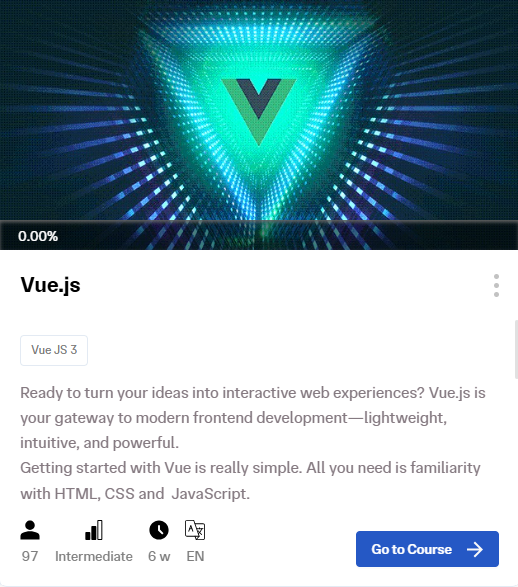
The course covers Vue 3 from the ground up - data binding, components, directives, Composition API, Vue Router, Pinia, and building real applications with modern tooling.
The Vue.js Learning Roadmap
Here's the sequence that takes you from zero to job-ready with Vue:
Step 1: HTML, CSS, and JavaScript Fundamentals
No framework matters without these. Learn DOM manipulation, event handling,
fetch, async/await, and ES6+ syntax before touching Vue.Step 2: Vue 3 Core
Components, props, events,
ref(), reactive(), computed(), watch(), lifecycle hooks, and template directives. This is the foundation everything else builds on.Step 3: Vue Router
Client-side navigation, dynamic routes, route guards, nested routes. Understanding routing turns a collection of components into a real application.
Step 4: Pinia
State management for data that needs to be shared across multiple components - user auth state, cart contents, API data.
Step 5: Nuxt.js
Server-side rendering, file-based routing, full-stack Vue. Nuxt is what takes a Vue developer from "frontend only" to full-stack capable.

Step 6: TypeScript with Vue
Required for most professional roles. Once you're comfortable with Vue's JavaScript API, TypeScript adds type safety and dramatically improves your tooling and code quality.
Vue vs Next.js: What About the React Side?
Many developers ask whether they should learn Vue or Next.js (which is React + SSR). It's a fair question - both are modern, both support SSR, and both are actively used in production.
The short answer: the underlying language knowledge matters more than the framework. Vue and Next.js both need strong JavaScript fundamentals. Both use component-based architecture. Both support TypeScript. The concepts you learn in one transfer directly to the other.
If your team or target employers use Next.js, that's a reason to learn it. If you want the gentler learning curve to start, Vue gets you productive faster.
The best frontend developers understand the landscape - they don't just know one tool.
Can You Get a Job with Vue.js?
Yes. Vue.js skills open real doors:
Frontend Developer - Vue + JavaScript + CSS is a complete stack for many roles. Companies building internal tools, dashboards, and SPAs often use Vue specifically.
Full-Stack Developer - Nuxt.js + Node.js or Laravel (Vue is especially popular in the PHP world) makes you a full-stack developer with modern tooling.
UI Developer - Component libraries and design systems built in Vue are common in companies that want consistent UI across their products.
One important note: Vue job listings aren't as dominant as React in the US, but Vue knowledge makes you a stronger candidate for React roles too. The concepts overlap significantly. Developers who understand Vue's reactivity system pick up React hooks faster than developers who start from scratch. Framework knowledge compounds.
The Full Frontend Track
Vue.js is one piece of a broader frontend skill set. Knowing JavaScript deeply, understanding how browsers work, building accessible and responsive UIs, working with APIs, using version control - these are the foundations that make a framework actually useful.
At Archi's Academy, the Frontend Development track covers the full stack of skills you need to get hired: HTML, CSS, JavaScript, React, TypeScript, and more - all through real work simulations with pull request reviews from experienced instructors. Not tutorials. Not videos. Real projects that look like real dev work.

Frequently Asked Questions
Is Vue.js still worth learning in 2026?
Yes. Vue 3 is actively maintained, widely used in production, and has strong momentum in European, Asian, and startup markets. Vue skills also transfer directly to React - learning Vue makes you a better frontend developer regardless of which framework you end up using day-to-day.
Should I learn Vue or React first?
If you're a complete beginner, Vue's gentler learning curve makes it a faster path to understanding how frameworks work. Once you understand components, reactivity, and the component lifecycle, learning React is significantly easier. That said, if your target employers use React, go there directly.
What's the difference between Vue 2 and Vue 3?
Vue 3 introduced the Composition API, improved TypeScript support, better performance, a smaller bundle size, and a new reactivity system. Vue 2 reached end of life in December 2023. All new projects should use Vue 3.
How long does it take to learn Vue.js?
With solid JavaScript fundamentals, you can learn Vue basics in 2–4 weeks. Reaching job-ready, intermediate level through real project work typically takes 3–6 months. The fundamentals matter more than the timeline - someone with weak JavaScript will struggle regardless of how long they spend on Vue.
Is Vue.js free?
Yes. Vue.js is completely free and open-source under the MIT license. Full documentation is at vuejs.org.
What is Nuxt.js and do I need it?
Nuxt.js is a framework built on top of Vue that adds server-side rendering, file-based routing, and full-stack capabilities. You don't need Nuxt to learn Vue - start with core Vue first. But if you're building a public-facing website that needs SEO, or you want to build full-stack apps with Vue, Nuxt is the next step.
The Bottom Line
Vue.js is one of the most accessible and capable frontend frameworks available in 2026. Its progressive design means you can start small and scale to any complexity. Its Composition API means large codebases stay maintainable. Its ecosystem - Vue Router, Pinia, Nuxt.js - means you have everything you need to build production applications without hunting for third-party solutions.
The developers who thrive in frontend aren't the ones who memorized one framework. They're the ones who understand how reactivity works, what components are for, how state flows through an application. Vue teaches all of that - clearly, quickly, and without unnecessary complexity.
If you're ready to go beyond reading docs and start building real things with real feedback, the Frontend Development track at Archi's Academy is where to do it.
Learn by Doing. Prove by Doing. Get Hired.
Have questions about Vue.js or which framework to learn first? Reach out to the Archi's Academy team - we're happy to help you figure out the right path.

Salı, Şub 16, 2021