



Software Development
Computer programming
Coding
MERN Stack in 2026: The Full-Stack JavaScript Path That Actually Gets You Hired
You don't need four languages to build the web. You need one - and the right stack to use it everywhere.
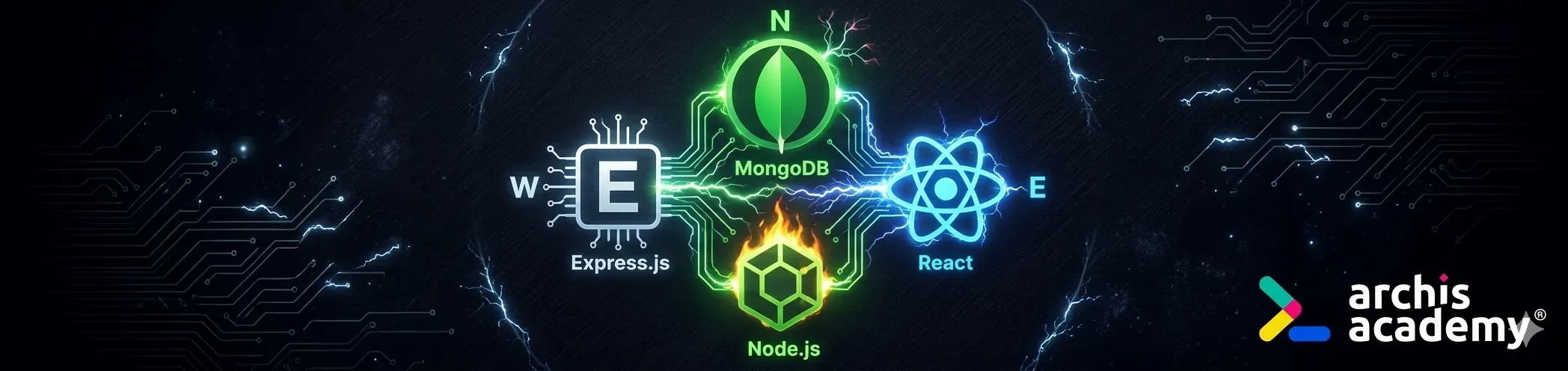
Why Full-Stack? Why Now? Why This Stack?
Let's start where it actually matters - not with what MERN is, but with why anyone should care.
The most valuable person on any product team isn't the one who knows the most - it's the one who can own the most. The developer who can build a database, wire up a server, design an API, and make the frontend talk to all of it without waiting on anyone else. That person can ship ideas end-to-end. They can build their own startup. They can walk into any job interview with a portfolio of complete, working products - not just half-finished UIs or backend scripts nobody can see.
That's what full-stack development gives you. And in 2026, MERN - MongoDB, Express.js, React, and Node.js - is one of the clearest, most employable paths to get there.
One language. One ecosystem. Total ownership of what you build.
Hold that image. Everything below is in service of it.
What Is the MERN Stack, Really?
MERN is four technologies that work together to form a complete web application - from the database all the way to what users see on their screen. The magic is that all four run on JavaScript, which means you're not context-switching between Python and Ruby and SQL and JavaScript. You write one language, and it handles everything.
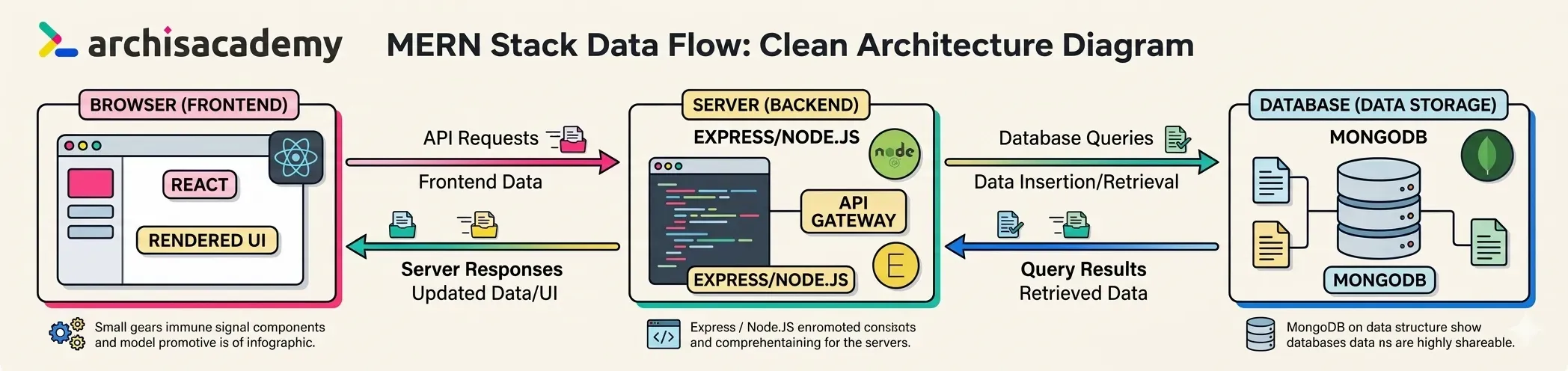
Here's how the layers stack up:
| Technology | Role | What it does for you |
|---|---|---|
| MongoDB | Database | Stores your data as flexible JSON-like documents |
| Express.js | Backend Framework | Handles HTTP requests and routes them to the right logic |
| React.js | Frontend Library | Builds the UI users actually see and interact with |
| Node.js | Runtime | Lets JavaScript run on the server, not just the browser |
Together, they cover every layer of a modern web app. Let's break each one down - and show you exactly where to start learning each one.
The Four Technologies, Explained
Node.js - JavaScript, Unleashed from the Browser
Before Node.js existed, JavaScript could only run inside a browser. Node changed that entirely. It took JavaScript out of the browser and put it on the server - meaning the same language you use to build a button on a webpage can now power the entire backend behind it.
Node is the foundation that makes the rest of MERN possible. Every Express server you run, runs on Node.
Where to start: → Node.js - Free Course on Archi's Academy
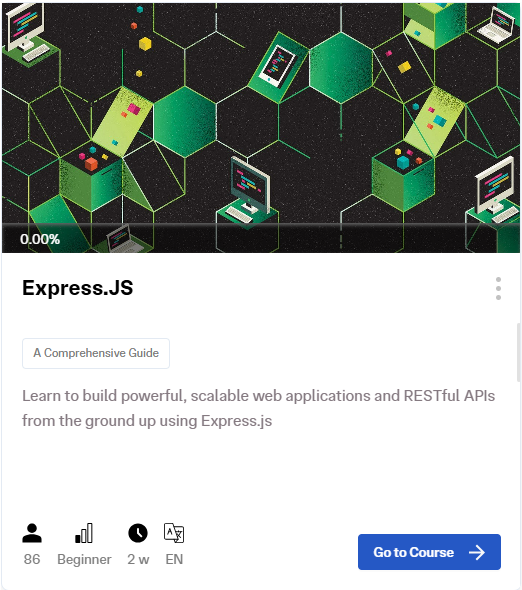
Express.js - The Layer That Makes Your Server Make Sense
Node.js gives you a server. Express.js gives you the structure to do something useful with it.
Express is a lightweight framework that sits on top of Node and makes it easy to define API routes, handle requests and responses, add authentication middleware, and keep your server code organised. Without it, building a backend API in raw Node would be verbose and fragile. With it, you're writing clean, readable routes in minutes.
In 2026, Express remains the default backend framework for MERN applications - and the one most employers expect you to know.
Where to start: → Express.js - Free Course on Archi's Academy
MongoDB - A Database That Speaks JavaScript
Most databases speak SQL - a separate language you have to learn on top of everything else. MongoDB is different. It stores data as JSON-like documents, which means the data coming out of your database looks exactly like the data flowing through your Node/Express server and into your React frontend. No translation layer. No friction.
For beginners especially, this is a genuine advantage. You're thinking in one data format the entire time.
MongoDB Atlas - the cloud-hosted version - also means you can have a production-ready database running in minutes without configuring a server yourself.
Where to start: → MongoDB - Free Course on Archi's Academy

React - The Frontend That Brings It All Together
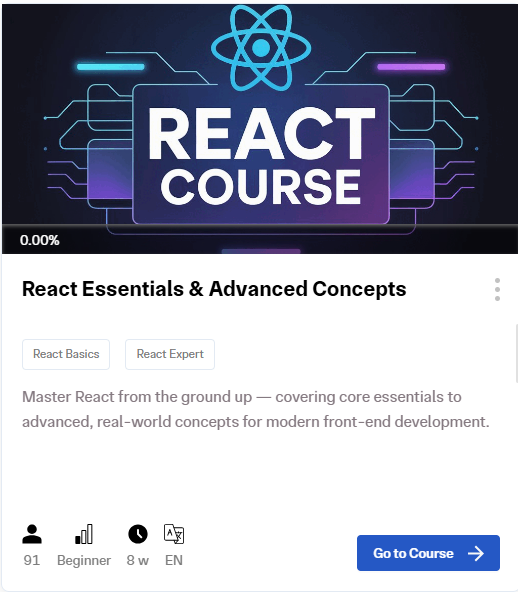
React is how your users experience everything you've built in the backend. It's a JavaScript library for building user interfaces - and it's been the dominant choice for frontend development for nearly a decade.
In a MERN app, React is responsible for fetching data from your Express API, displaying it cleanly, handling user interactions, and updating the UI without refreshing the whole page. It's fast, component-based, and the most in-demand frontend skill in job postings globally.
If you're coming from the frontend development path, you already know React. In MERN, you just connect it to a real backend you also built.
Where to start: → React.js - Free Course on Archi's Academy
MERN + AI: Full-Stack Development in 2026
The MERN stack hasn't changed much structurally - but how developers build with it has shifted dramatically.
AI tools have entered the full-stack workflow at every layer:
- GitHub Copilot - Writes Express routes, MongoDB queries, and React components from your comments and context.
- Cursor - An AI-first code editor that understands your entire codebase. Ask it to wire up an API endpoint and it will - across multiple files at once.
- v0 by Vercel - Generate React UI components from a text description. The fastest way to go from wireframe to working frontend.
- Bolt.new - Spin up a full-stack MERN-style app from a single prompt. Useful for prototyping ideas in minutes.
But here's the honest reality: AI generates code. It doesn't understand your application.
It doesn't know that your MongoDB schema needs to match your API contract. It doesn't know your Express middleware is running in the wrong order. It doesn't know your React component is causing unnecessary re-renders. You need to know these things - or you'll ship AI's bugs, just faster.
The MERN developer who understands the fundamentals deeply is the one who can use AI effectively. The one who skips the fundamentals is the one who can't figure out why the AI's code doesn't work.
The MERN Developer Skill Set in 2026
Beyond the four core technologies, here's what separates hireable MERN developers from people who've just followed tutorials:
Technical skills that matter:
- JavaScript (ES6+) - async/await, destructuring, modules - deeply, not just surface level
- RESTful API design - how to structure endpoints that make sense
- State management in React - Context API for simpler apps, Redux or Zustand for complex ones
- Authentication - JWT, sessions, OAuth basics
- MongoDB data modelling - how to design schemas that scale
- Git and GitHub - non-negotiable for any team environment
- Deployment - at minimum, knowing how to push a MERN app to a platform like Railway, Render, or Vercel
The skill employers actually test for:
Real projects. Working applications. Code on GitHub. Not certificates - proof.
A Realistic MERN Learning Roadmap
Phase 1 - JavaScript Foundations (Month 1–2)
Before MERN, you need solid JavaScript. Async/await, fetch, array methods, ES6 syntax. This is not optional. Everything else builds on it.
Phase 2 - React Fundamentals (Month 2–3)
Components, props, state, hooks, routing with React Router. Build a few static and dynamic UIs.
→ Start React for free →
Phase 3 - Node.js + Express (Month 3–4)
Build your first API. Learn routing, middleware, error handling, and how to connect a frontend to a backend endpoint.
→ Start Node.js for free →
→ Start Express.js for free →
Phase 4 - MongoDB (Month 4–5)
Schema design with Mongoose, CRUD operations, connecting your Express server to a live MongoDB Atlas database.
→ Start MongoDB for free →
Phase 5 - Build Full-Stack Projects (Month 5–6+)
Connect all four. Start with a to-do app with user auth, then a blog platform, then something of your own. Deploy it. Share it.
🚀 Ready to start right now? All four courses - Node, Express, MongoDB, React - are free to begin on Archi's Academy. No friction, no credit card. Browse All Free Courses →
Common MERN Mistakes (and How to Avoid Them)
Skipping JavaScript fundamentals. MERN is all JavaScript. If you're shaky on promises, closures, or async/await - the framework confusion is actually JavaScript confusion. Fix the root.
Treating it as one big thing. Learn each technology separately and understand what it does before combining them. Confusion usually happens at the integration layer, not within any single technology.
Never deploying anything. Local projects are practice. Deployed projects are proof. Even a basic app on Railway or Render counts enormously in a portfolio.
Ignoring error handling. In Express, unhandled errors crash your server. In React, unhandled fetch failures silently break your UI. Error handling isn't advanced - it's basic professionalism.
Building the same tutorial app forever. The to-do app teaches you the pattern once. After that, build something you actually want to use.
The Bigger Picture: What Full-Stack Really Gives You
Here's the thing about MERN that no tutorial will tell you upfront.
The technology is not the point. The point is what you can do with it.
With MERN, you can build the same category of application that powers major global products. Not toys - real, deployable, scalable web applications with databases, user authentication, real-time data, and polished frontends. From one person, with one language, in one ecosystem.
That's genuinely rare. And in 2026, with AI handling more boilerplate than ever, the ceiling on what a skilled solo MERN developer can ship is higher than it's ever been.
The question isn't whether MERN is worth learning. It's whether you're willing to build through the hard phases to get there.
Where Archi's Academy Fits In
Knowing MERN and being able to prove you know MERN are two different things.
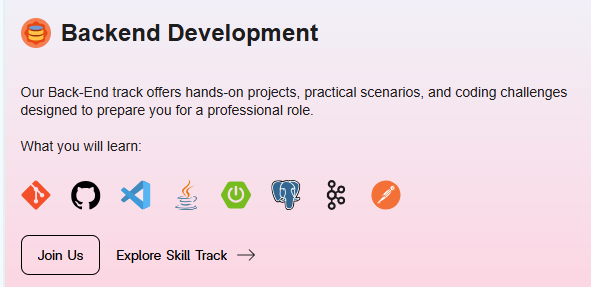
At Archi's Academy, the Backend Development track is built around exactly this - project-based work simulations that mirror what a junior full-stack developer actually does on the job. Not exercises. Not quizzes. Real scenarios where you build real things under real constraints.
Pair it with the Frontend Development track and you have a complete, end-to-end MERN portfolio before you ever apply for a single job.
Learn by Doing. Prove by Doing. Get Hired.

Not sure which track is right for you, or want to talk through where to start? The Archi's Academy team works with beginners every day - reach out here and they'll point you in the right direction.

Salı, Oca 4, 2022